


Au-Some Books on Autism & Neurodiversity

Updated: Apr 28

Recommended Reading List of Au-some Books on Autism and Neurodiversity
These are a few Au-some books I love on Autism and Neurodiversity that are recommended and vetted by autistic adults and allies from our neuro-tribe.
The books are loosely organized info different categories, explore what you want to focus on. You can check them out below.
Books for Parents: Understanding and parenting your neurodivergent child

All Cats Are on the Autism Spectrum – Illustrated by Kathy Hoopmann
This updated edition of the bestselling All Cats Have Asperger Syndrome. All-new cats take a playful look at the world of autism, and these fun feline friends will strike a chord with all those who are familiar with typical autistic traits, bringing to life common characteristics such as sensory sensitivities, social issues and communication difficulties.
This is a great tool to use when you tell your child about their autism diagnosis. For more info on how to do this, read https://www.eunoiahomeschool.com/post/should-i-tell-my-child-about-their-autism-or-adhd-diagnosis-a-guide-for-parents

Your Child Is Not Broken by Heidi Mavir
“Your Child Is Not Broken” is THE book for parents who need permission to do things differently. Heidi Mavir almost died working out why that was necessary. Part autobiography, part parenting manual, “Your Child Is Not Broken” is a no-holds-barred account of Heidi Mavir’s discovery of her child’s neurodivergence.
It is the funny, irreverent and brutally honest story of Heidi’s fight to be seen, heard, and supported, whilst swimming against a tide of parent blame, ableist stereotypes, and the weight of other people’s opinions. It is the book no one has dared write but every parent needs to read.

I Will Die On This Hill: Autistic Adults, Autism Parents, and the Children Who Deserve a Better World by Jules Edwards, Meghan Ashburn, et al.
There is a significant divide between autistic advocates and parents of autistic children. Parents may feel attacked for their lack of understanding, and autistic adults who offer insight and guidance are also met with hostility and rejection. Meghan Ashburn, a mother of two autistic boys, and Jules Edwards, an autistic parent, were no strangers to this tension and had an adversarial relationship when they first met. Over time, the two resolved their differences and are now co-conspirators in the pursuit of disability justice.
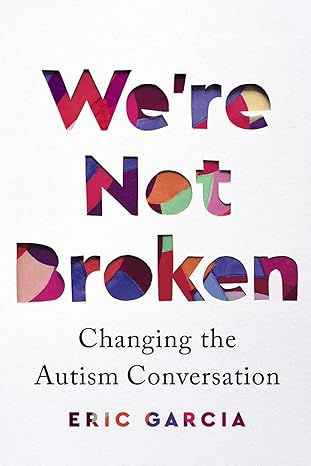
Were not Broken by Eric Garcia
“This book is a message from autistic people to their parents, friends, teachers, coworkers and doctors showing what life is like on the spectrum. It’s also my love letter to autistic people. For too long, we have been forced to navigate a world where all the road signs are written in another language.”
In We’re Not Broken, Garcia uses his own life as a springboard to discuss the social and policy gaps that exist in supporting those on the spectrum. From education to healthcare, he explores how autistic people wrestle with systems that were not built with them in mind.

Born on a Blue Day by Daniel Tammet.
Bestselling author Daniel Tammet (Thinking in Numbers) is capable of living a fully independent life and able to explain what is happening inside his head. He sees numbers as shapes, colors, and textures, and he can perform extraordinary calculations in his head.
He can learn to speak new languages fluently, from scratch, in a week. In 2004, he memorized and recited more than 22,000 digits of pi, setting a record.
He has savant syndrome, an extremely rare condition that gives him the most unimaginable mental powers, much like those portrayed by Dustin Hoffman in the film Rain Man.
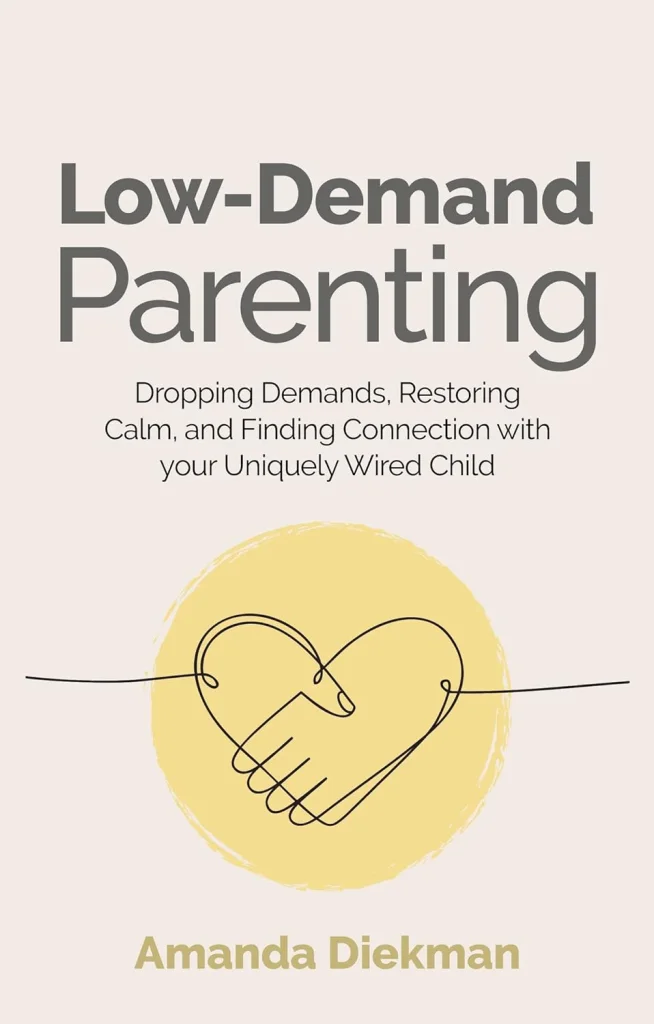
Low Demand Parenting by Amanda Diekman
“Low-demand parenting requires radical acceptance. It says to the kid right in front of you, I see you, just as you are. – You are ok here. I love you right here.”
Parent to neurodivergent children and autistic adult, Amanda Diekman, outlines a parenting approach that finally lowers the bar for the whole family, enabling the equilibrium of the home to be restored.
Low-demand parenting allows you to drop the demands and expectations that are making family life impossible and embrace the joyful freedom of living life with low demands.

Sincerely, your autistic child by the Autistic Women and Nonbinary Network
A diverse collection of autistic voices that highlights how parents can avoid common mistakes and misconceptions, and make their child feel truly accepted, valued, and celebrated for who they are.
Most resources available for parents come from psychologists, educators, and doctors, offering parents a narrow and technical approach to autism. Sincerely, Your Autistic Child represents an authentic resource for parents written by autistic people themselves. They reflect on what they have learned while growing up on the autism spectrum and how parents can avoid common mistakes.

Lost at School: Why Our Kids with Behavioral Challenges are Falling Through the Cracks and How We Can Help Them by Ross W. Greene Ph.D
Dr. Ross W. Greene, author of the acclaimed book The Explosive Child, offers educators and parents a different framework for understanding challenging behavior in neurodiverse children. Dr. Greene’s Collaborative & Proactive Solutions (CPS) approach helps adults focus on the true factors contributing to challenging classroom behaviors, empowering educators to address these factors and create helping relationships with their most at-risk kids through collaborative problem solving and proactive solutions.
Books by Non-speaking Autistic Authors

Ido in Autismland opens a window into non-verbal autism through dozens of short, autobiographical essays each offering new insights into autistic traits, effective and ineffective treatments and the inner emotional life of a non-speaking autistic boy.
In his pithy essays, author Ido Kedar, a brilliant sixteen year old with autism, challenges what he believes are misconceptions in many theories that dominate autism treatment today while he simultaneously chronicles his personal growth in his struggles to overcome.

In Two Worlds by Ido Kedar
In Two Worlds is a compelling tale, rich with unforgettable characters who are navigating their way through the multitude of theories about autism that for decades have dictated the lives of thousands of children and their families.
This debut work of fiction sheds light on the inner and outer lives of children with nonspeaking autism, and on their two worlds.
As one of the only works of fiction written by a person with non-speaking autism, it offers readers an unprecedented insider’s point-of-view into autism and life in silence, and it does so with warmth, humor and a wickedly sharp intellect.

The Reason I Jump by Naoki Higashida
NAMED ONE OF THE BEST BOOKS OF THE YEAR BY NPR • The Wall Street Journal • Bloomberg Business • BookishFINALIST FOR THE BOOKS FOR A BETTER LIFE FIRST BOOK AWARD • NEW YORK TIMES BESTSELLER
You’ve never read a book like The Reason I Jump. Written by Naoki Higashida, a very smart, very self-aware, and very charming thirteen-year-old boy with autism.
It is a one-of-a-kind memoir that demonstrates how an autistic mind thinks, feels, perceives, and responds in ways few of us can imagine.

Fall Down 7 Times Get Up 8 by Naoki Higashida
From the author of the bestselling The Reason I Jump. Now, in Fall Down 7 Times Get Up 8, he shares his thoughts and experiences as a young man living each day with autism. In short, powerful chapters, Higashida explores school memories, family relationships, the exhilaration of travel, and the difficulties of speech. He also allows readers to experience profound moments we take for granted, like the thought-steps necessary for him to register that it’s raining outside. Acutely aware of how strange his behavior can appear to others, he aims throughout to foster a better understanding of autism and to encourage society to see people with disabilities as people, not as problems.

Anatomy of Autism by Diego M. Pena
#1 Bestseller on Amazon!
"Trust me, I want to talk to you. My inability to speak is confused for my intelligence.” Diego Peña is a sharp-witted 9 year old boy whose goal is to deliver a message that shatters misconceptions about autism. Only Diego cannot yet speak. By pointing to letters on a laminated letter board and typing on a keyboard, he breaks through his silence to express his inner-thoughts in Anatomy of Autism.
In this pocket guide for individuals who support autistic students, Diego concisely articulates the challenges and dilemmas he faces with his sensory system, communication, and motor system. He thoughtfully explores the implications and possibilities of these challenges as a primary school student.
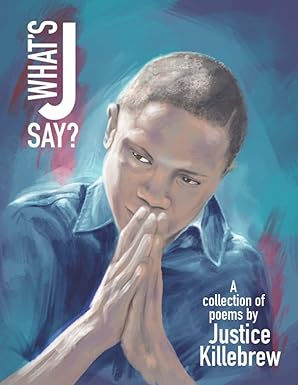
What's J Say?: A Collection of Poems by Justice Killebrew
“What’s J Say?” is a remarkable collection of the inner thoughts of 16-year-old Justice Reign Killebrew, transformed into a poetic masterpiece. Justice is nonspeaking, has autism, and types to communicate. He proves through his writings that he is fully aware of his surroundings and communicates his perspective with the intelligence of a scholar, and the wit of an “old soul."
“What’s J Say?” is an excellent introduction to the multifaceted teenager who plans to change the world through love and action.
Books for Autistic Adults: Autism Theory, Self-Care, Self-Regulation, Autistic Women & Autistic Burnout

Uniquely Human: a Different Way of Seeing Autism by Dr. Barry M Prizant
Winner of the Autism Society of America’s Dr. Temple Grandin Award for the Outstanding Literary Work in Autism
A groundbreaking book on autism, that portrays autism as a unique way of being human - this is “required reading. Breathtakingly simple and profoundly positive” (Chicago Tribune).
This updated and expanded edition of Dr. Barry M. Prizant’s Uniquely Human tackles diversity of identity in the autism sphere, and the future of autistic advocacy by amplifying the voices of autistic and neurodivergent individuals.

NeuroTribes: the Legacy of Autism and the Future of Neurodiversity by Steve Silberman
This New York Times–bestselling book upends conventional thinking about autism and suggests a broader model for acceptance, understanding, and full participation in society for people who think differently.
“Beautifully told, humanizing, important.”—The New York Times Book Review
“Breathtaking.”—The Boston Globe“Epic and often shocking.”—Chicago Tribune

Divergent Mind by Jenara Nerenberg
The bestselling, paradigm-shifting study of neurodivergent women - those with ADHD, autism, synesthesia, high sensitivity, and sensory processing disorder - exploring why these traits are overlooked in women and how society benefits from allowing their unique strengths to flourish.
Divergent Mind is the much-needed answer for women who have a deep sense that they are “different.” Sharing real stories from women with high sensitivity, ADHD, autism, misophonia, dyslexia, SPD, and more, Nerenberg explores how these brain variances present differently in women and dispels widely-held misconceptions.

Welcome To the Autistic Community by Lar Berry and The Autistic Self Advocacy Network. You can also read this book online here.
This book is about what it means to be a part of the autistic community. Autistic people wrote this book. Some autistic people are just learning about their autism. The authors wanted to welcome them and give them a lot of important information all in one place.
This book talks about what autism is and how it affects our lives. It talks about our history, our community, and our rights. The authors wrote this book in plain language so that more people can understand it.
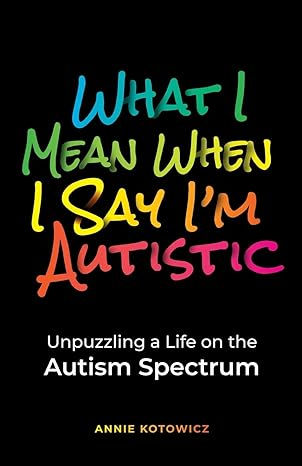
What I Mean When I Say I'm Autistic: Unpuzzling a Life on the Autism Spectrum by by Annie Kotowicz
In this intimate and insightful mix of memoir and manifesto, Annie Kotowicz invites you inside the mind of an autistic woman, sharing the trials and triumphs of a life before and after diagnosis. Drawing on popular stories from her blog Neurobeautiful - along with memories never shared before - Annie Kotowicz has created a nuanced analysis of her autistic thinking.
What I Mean When I Say I’m Autistic will inspire autistic people and those who love them, offering help and hope to anyone seeking a deeper understanding of the autism spectrum.
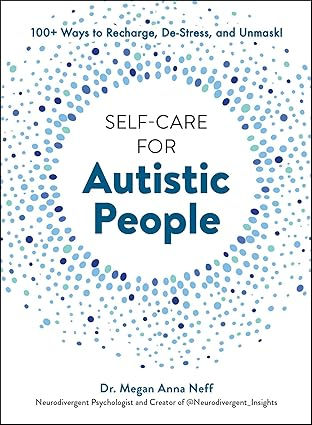
Self-Care for Autistic People: 100+ Ways to Recharge, De-Stress, and Unmask by Dr. Megan Anna Neff
Ditch the stigma, celebrate your identity, and put yourself first with these 100+ exercises that reinforce the idea that neurodiversity is a strength and teaches you how to relax, destress, find your community, practice self-love, and more.
When you’re autistic, it can be tough to prioritize wellness.
Self-Care for Autistic People can help you engage in some neurodivergent self-care—without pretending to be neurotypical.

The Autistic Burnout Workbook: Your Guide to Your Personal Recovery Plan (Self-Care for Autistic People) by Dr. Megan Anna Neff
Navigate the challenging terrain of autistic burnout with expert guidance, insightful visuals, and transformative exercises designed to help you pursue your own recovery from neurodivergent psychologist Dr. Megan Neff.
Feeling burnt out? You’re not alone.
Autistic burnout is a challenge faced by many individuals on the autistic spectrum.

"To think of PDA as merely involving demand avoidance is to me akin to thinking of tigers as merely having stripes."
This book is a unique window into adult Pathological Demand Avoidance (PDA), exploring the diversity of distinct PDA traits through the voices of over 70 people living with and affected by the condition.
Sally Cat, an adult with PDA, has successfully captured the essence of a popular online support group in book form, making the valuable insights available to a wider audience, and creating a much-needed resource for individuals and professionals.

Loud Hands: Autistic People Speaking (Anthology) by Julia Bascom
Loud Hands: Autistic People, Speaking is a collection of essays written by and for Autistic people.
Spanning from the dawn of the Neurodiversity movement to the blog posts of today.
Loud Hands: Autistic People, Speaking catalogues the experiences and ethos of the Autistic community and preserves both diverse personal experiences and the community’s foundational documents together side by side.

Nerdy, Shy, and Socially Inappropriate by Cynthia Kim
Cynthia Kim explores all the quirkiness of living with Asperger Syndrome (Autism) in this accessible, witty and honest guide looking from an insider perspective at some of the most challenging and intractable aspects of being autistic. Her own life presents many rich examples.
From being labelled nerdy and shy as an undiagnosed child to redefining herself when diagnosed with Asperger Syndrome as an adult, she describes how her perspective shifted to understanding a previously confusing world and combines this with the results of extensive research to explore the ‘why’ of ASD traits.

The Ultimate Guide to Thriving with Adult Autism by Elliot Reese
Elliot Reese is a neurodivergent writer and mental health advocate whose late autism diagnosis reshaped the way she understood her life. After years of burnout and masking, she began writing the kind of resources she wished she’d had.
"This book offers a powerful and practical path forward for late-diagnosed autistic adults. Rather than simply explaining neurodivergence, it guides readers from overwhelm and disconnection toward meaningful routines, sensory balance, and authentic social connection. I recommend it as a therapeutic tool for anyone seeking not just to cope, but to truly thrive." - Nazish Chaudhary, PhD, Clinical Psychology

Autistic Masking: Understanding Identity Management and the Role of Stigma by Amy Pearson & Kieran Rose
Masking is a form of identity management involving consciously or unconsciously suppressing aspects of identity and action. Often seen in socially marginalized groups, it is found to contribute towards poorer outcomes for autistic people and is related to higher prevalence of suicidality, exhaustion, burnout, and mental health difficulties. Taking an intersectional lens to consider how autistic identity may interact with other aspects of selfhood, the authors will provide a holistic understanding of the most up-to-date evidence.
Workplace Wellness: Navigating the Work Environment as an Autistic Adult

Workplace Neurodiversity Rising by Lyric Rivera
Having a supportive environment can be the difference between employee success and failure. When we support the diverse minds within an organization, everyone on the team benefits (because much of what is necessary for NeuroDivergent success, will benefit everyone in a company).
This book is designed to be read front to back, but is also organized in sections, to allow you to skip to your organization’s specific problem areas (since every organization is unique).
The author also included a handy glossary of terms at the back of this book.

The Canary Code: A Guide to Neurodiversity, Dignity, and Intersectional Belonging at Work by Ludmila N. Praslova PhD
The Canary Code reorganizes work for thriving - starting with those first impacted by faulty systems, like canaries first sensing toxic air in coal mines. Neurodivergent talent (members of ADHD, autism, Tourette’s syndrome, and learning-differences communities, and others who think and experience life differently) offer unique skills and exceptional work ethics, yet face employment barriers. Their unique abilities and perspectives are excluded, and their canary warnings about bullying, broken workflows, or ethical drift are ignored.
Books for Autistic Tweens, Teens & Young Adults

The Awesome Autistic Go-To Guide: A Practical Handbook for Autistic Teens and Tweens by Yenn Purkis and Tanya Masterman
This book explores what it feels like to be a young person on the autism spectrum and looks at all the brilliant things people on the autism spectrum can do. Full of insights about being awesome and autistic, this book celebrates the strengths of understanding the world in a different way. It also has tips for managing tricky situations such as meltdowns, sensory differences and anxiety. It includes fun activities and diary pages where you can write your thoughts and feelings to help you concentrate on your strengths and work on your challenges.

The Spectrum Girl's Survival Guide by Siena Castellon
"Never be ashamed of being different: it is this difference that makes you extraordinary and unique."
This essential go-to guide gives you all the advice and tools you'll need to help you flourish and achieve what you want in life.
From the answers to everyday questions such as 'Am I using appropriate body language?' and 'Did I say the wrong thing?', through to discussing the importance of understanding your emotions, looking after your physical and mental health and coping with anxiety and sensory overloads, by award-winning neurodiversity campaigner Siena Castellon.

Afrotistic - A Novel by Kala Allen Omeiza
“Engaging and empathetic story for adolescents everywhere.”
—The Oxford Business Review
Noa Ohunene Jenkins doesn't feel Black enough. Or autistic enough. Or cool enough. In her new town, the fifteen-year-old strives to make Dean's Merit Society, an elite honor society that she sees as her ticket to success. To make the society, she needs leadership experience, but there's one problem: Noa struggles to socialize appropriately.
With the assistance of the Roaring Pebbles, a robot toy invention, her nonspeaking brother, Noa clings to her chance to make the society — and to one day, finally feel enough.
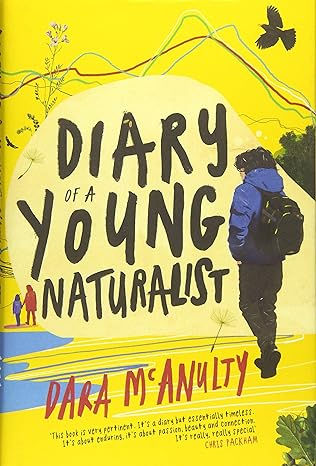
Diary of a Young Naturalist by Dara McAnulty
From Dara McAnulty, a globally renowned figure in the youth climate activist movement, comes a memoir about loving the natural world and fighting to save it.
Diary of a Young Naturalist chronicles the turning of a year in Dara’s Northern Ireland home patch. As well as Dara’s intense connection to the natural world, Diary of a Young Naturalist captures his perspective as a teenager juggling exams, friendships, and a life of campaigning.
We see his close-knit family, the disruptions of moving and changing schools, and the complexities of living with autism.

I Am Autistic: A Workbook: Sensory Tools, Practical Advice, and Interactive Journaling for Understanding Life with Autism by Chanelle Moriah
Navigate the world of autism with this inclusive, full-color autism workbook for those interested in learning more about ASD, getting an early autism diagnosis, and recognizing how being autistic can impact a person’s daily life.
Author and illustrator Chanelle Moriah offers an interactive autism tool for both formally diagnosed autistics and self-diagnosed autistics.

The Young Autistic Adult's Independence Handbook by Haley Moss
Are you living away from home for the first time, graduating from school or perhaps getting a new job? These transitions can be especially overwhelming to deal with as a young autistic adult. This survival guide is bursting with neurodivergent-friendly advice from autistic people themselves (and a few neurotypicals too) for young adults embarking on their own journeys of self-discovery and independence.
From guidance on organizing your own money, looking after your home and organizing your social life to tips on self-advocacy and important life skills such as driving, voting and volunteering, Haley Moss has you covered.

As a university student with High-Functioning Autism, Haley Moss offers essential tips and advice in this insider's guide to surviving the first year of college or university.
Chatty, honest and full of really useful information, Haley's first-hand account of the college experience covers everything students with Autism Spectrum Disorders need to know. She talks through getting ready for college, dorm life and living away from parents, what to expect from classes, professors and exams, and how to cope in new social situations and make friends.
Books on gender-diversity & LGBTQIA+

In this empowering and honest guide for LGBTQIA+ autistic teens, Erin Ekins gives you all the tools you need to figure out and explore your gender identity and sexuality.
From coming out to friends and family, staying safe in relationships and practicing safe sex, through to self-care and coping with bullying, being out and about in the LGBTQIA+ community and undergoing gender transition, this book is filled with essential information, advice, support and resources to help you on your journey, and also works as a primer on all things LGBTQIA+ for non-autistic teens who are just figuring it all out.

The Awesome Autistic Guide to Trans Teens by Yenn Purkis and Sam Rose
Calling all awesome autistic trans teens! Yenn Purkis and Sam Rose gives helpful explanations, tips and activities, plus examples of famous trans and gender divergent people on the autism spectrum, this user-friendly guide will help you to navigate the world as an autistic trans teen.
Covering a huge range of topics including coming out, masking, different gender identities, changing your name, common issues trans and gender divergent people face and ways to help overcome them, building a sense of pride and much, much more, it will empower you to value yourself and thrive exactly as you are.

Neuroqueer Heresies: Notes on the Neurodiversity Paradigm, Autistic Empowerment, and Postnormal Possibilities by Nick Walker
The work of queer autistic scholar Nick Walker has played a key role in the evolving discourse on human neurodiversity.
Neuroqueer Heresies collects a decade’s worth of Dr. Walker’s most influential writings, along with new commentary by the author and new material on her radical conceptualization of Neuroqueer Theory.
This book is essential reading for anyone seeking to understand the foundations, terminology, implications, and leading edges of the emerging neurodiversity paradigm.
More Book Lists for You to Explore
For a thoroughly comprehensive list I highly recommend 100-ish Books on Autism and Neurodiversity by NotAnAutismMom and her Book Lists & Book Club.
If you’re looking for more books on autism and neurodiversity, this is the place to look, there are plenty to choose from as expertly compiled by Megan.

CLICK HERE for the list 100-ish Books on Autism and Neurodiversity

CLICK HERE if you’re only searching for inclusive children’s books.

CLICK HERE if you’re only searching for books for teens, tweens, and adolescents.


Comments