


Neurodivergent Career Counseling


Choosing a career is not only about choosing a job title.
For many neurodivergent adults, career planning can feel confusing, overwhelming, or even painful. You may know that you are capable. You may have strengths, interests, ideas, qualifications, creativity, deep thinking, empathy, problem-solving ability, or a strong desire to contribute meaningfully.
And yet, work or study may still feel difficult.
Not because you are lazy.
Not because you are broken.
Not because you are “not trying hard enough.”
Often, the missing piece is fit.
A career path may look good on paper, but still be exhausting if the environment is too chaotic, vague, noisy, socially demanding, unpredictable, or unsupportive. A person can be highly skilled and still struggle when their support needs are ignored.
This is where Neurodivergent Career Counseling can be so helpful.
It offers a warm, structured, neuro-affirming space to explore who you are, what you need, what matters to you, and what kind of work may be more sustainable.
What Is Neurodivergent Career Counseling?

Neurodivergent Career Counseling is a strengths-based, neuro-affirming, person-centered process that supports Autistic, ADHD, AuDHD, dyslexic, and otherwise neurodivergent adults to explore career direction in a way that honors their whole profile.
It goes beyond a standard career test.
Instead of only asking:
“What job are you interested in?”
We also explore:
What kind of environment helps you thrive?
What drains your energy?
What support needs must be considered?
What values matter most to you?
What kind of work feels meaningful, realistic, and sustainable?
What accommodations could help you succeed?
This matters because career planning is not only about ability. It is also about the conditions that allow your abilities to show up.
The 3-Part Neurodivergent Career Counseling RoadMap
My Neurodivergent Career Counseling process focuses on three main areas:
1. Personality Profile
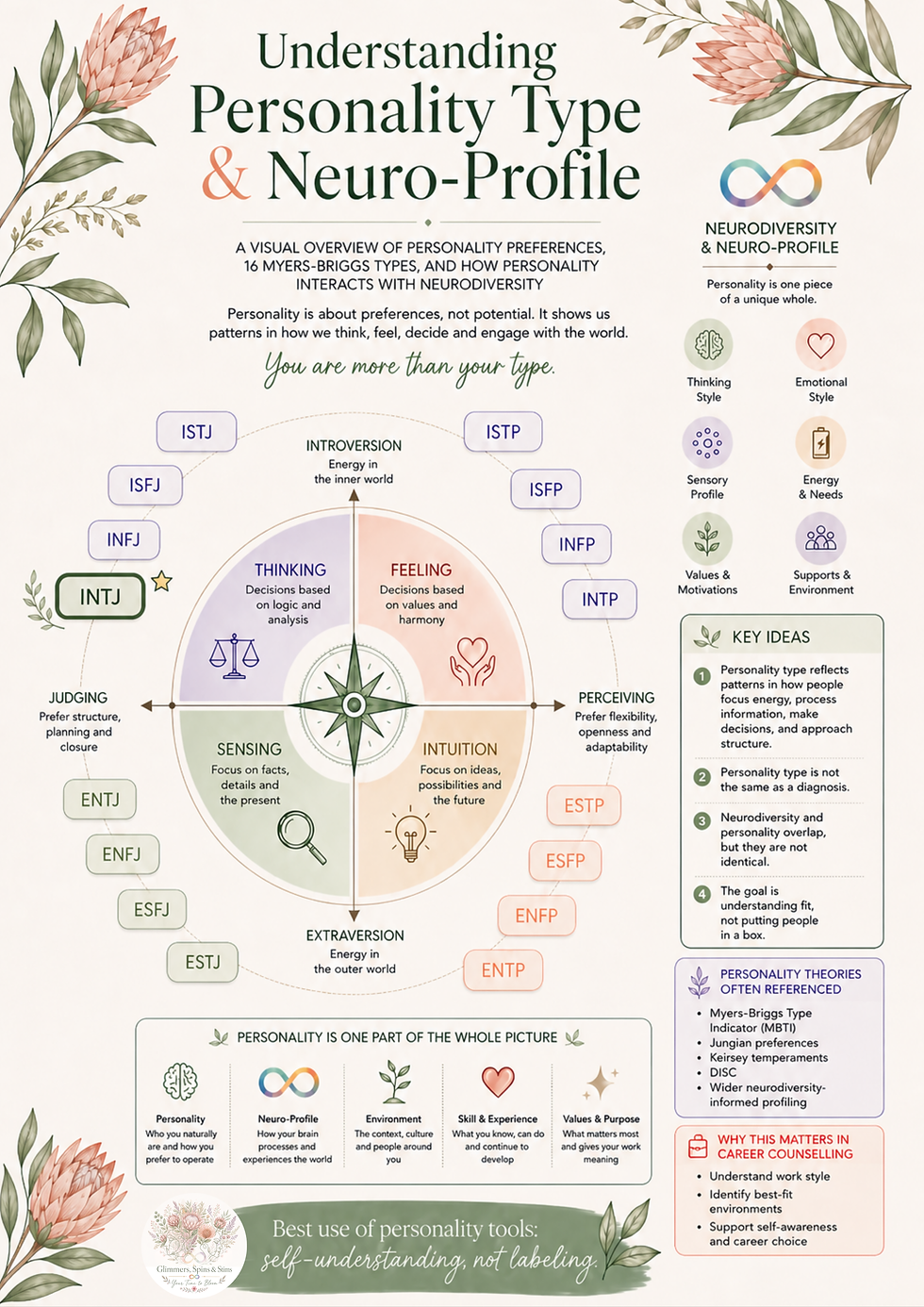
Career aptitude, work style, strengths and natural preferences
Your Personality Profile explores how you naturally think, make decisions, process information, organize your world, relate to others, and approach tasks.
This part helps us understand your natural aptitude, strengths, motivation, work style, decision-making patterns, and preferred ways of engaging with the world.
It helps answer questions such as:
What are my natural strengths?
How do I prefer to work?
What motivates me?
What drains me?
How do I make decisions?
What kind of structure helps me?
What work style fits me best?
This profile does not put you in a box. It gives us language for understanding how you naturally operate, so that your career planning can be more aligned with who you are.
2. Career Profile

Career interests, values, motivation and possible pathways
Your Career Profile explores your interests, values, career themes, preferred tasks, and possible study or work pathways.
This part looks at what you are drawn to and what kind of work may feel meaningful, interesting, realistic, and values-aligned.
It helps answer questions such as:
What fields am I interested in?
What kinds of tasks do I enjoy?
What problems do I like solving?
What values matter in my work?
What career clusters may fit my strengths and interests?
What study, training, or work options could I explore next?
The Career Profile helps identify possible career directions, best-fit themes, and practical next steps. It does not give one rigid answer. Instead, it helps create a clearer map of possibilities.
3. Neuro-Profile

Support needs, accommodations, environment fit and sustainability
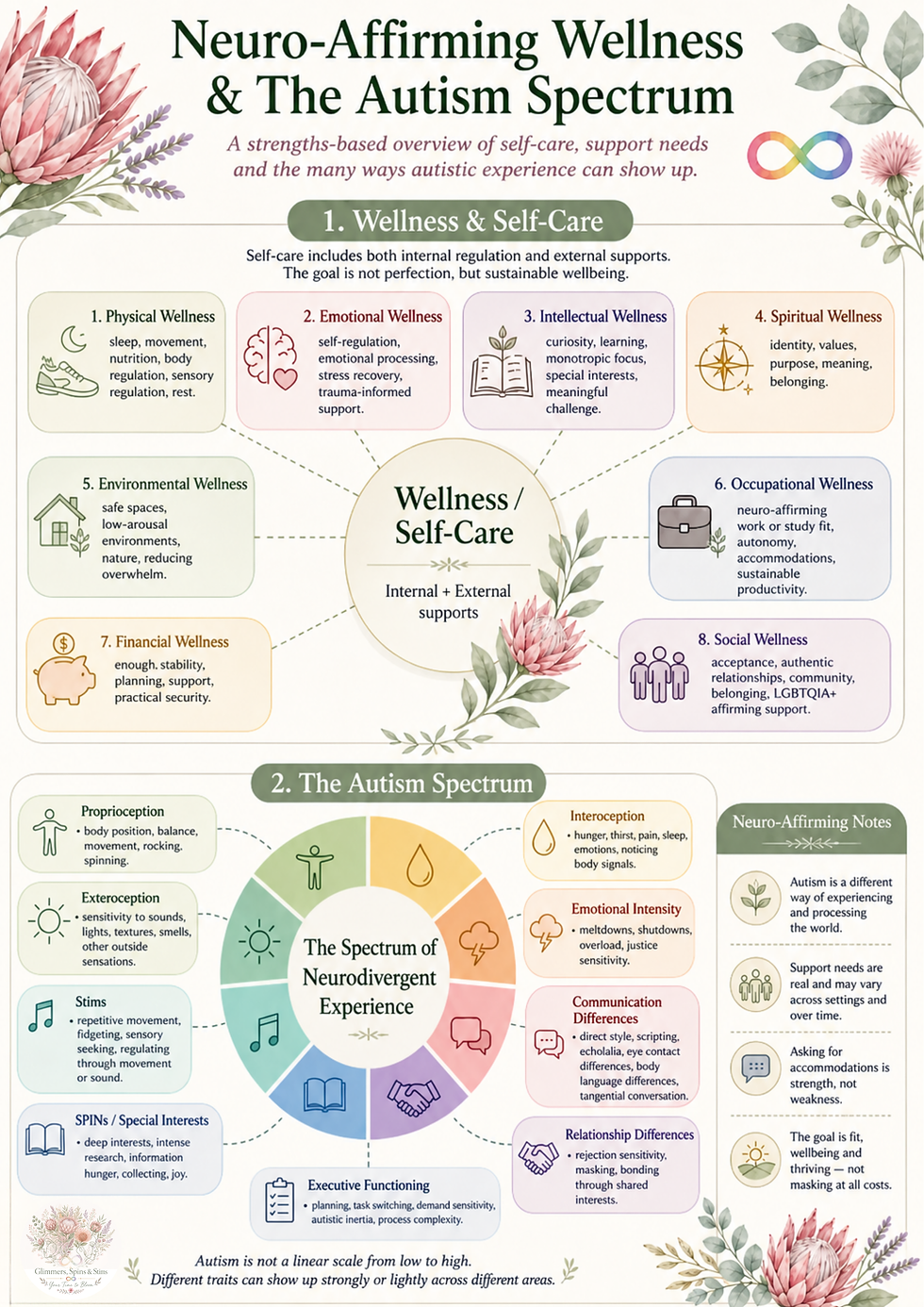
Your Neuro-Profile explores how your neurodivergent profile affects learning, work, energy, communication, sensory needs, executive functioning, masking, anxiety, burnout risk, and daily functioning.
This is the part that makes the process different from standard career guidance.
It helps answer questions such as:
What support do I need to thrive?
What environments help me function well?
What workplace red flags may increase stress or burnout?
What accommodations could support me?
What sensory, social, or communication needs should be considered?
What kind of work setting is most sustainable?
The Neuro-Profile helps ensure that career planning does not only focus on what you can do, but also on what you need in order to do it sustainably.
Together, these three areas create a fuller picture of who you are, what you are drawn to, and what you need in order to thrive.
Because the best career path is not only about ability — it is about fit, support, meaning, and sustainability.

Why Standard Career Guidance May Not Be Enough
Traditional career guidance often focuses on interests, school subjects, personality, and academic results. These are useful, but they may not tell the whole story.
For neurodivergent adults, career planning often also needs to consider:
Sensory needs
Executive functioning
Communication style
Social energy
Masking and camouflaging
Anxiety load
Burnout vulnerability
Work pace and structure
Need for autonomy
Values and identity
Workplace culture
Reasonable accommodations
A person may love a field, but struggle in a specific workplace environment.
A student may be academically capable, but need support with planning, transitions, deadlines, workload, or study-readiness.
An adult may be skilled and experienced, but feel burnt out after years of trying to survive in environments that required constant masking or over-performance.
Neurodivergent Career Counseling looks at the relationship between the person, the work, and the environment.
The goal is not to force you to fit into a career box.
The goal is to help you understand what kind of work and environment may fit you.
Why This Work Matters

Many neurodivergent adults carry years of internalized messages such as:
“I am too sensitive.”
“I am difficult.”
“I never finish things.”
“I am not reaching my potential.”
“I should be coping better.”
“I just need to try harder.”
But when we look through a neuro-affirming lens, the questions begin to change.
Instead of asking, “Why can’t I cope?” we ask:
What support would make this more possible?
What environment helps me function well?
What kind of work allows me to use my strengths without burning out?
What expectations are realistic, and what barriers need to be reduced?
This shift is powerful.
It helps move career planning away from shame and toward self-understanding.
You may discover that the problem was not your lack of potential. It may have been the lack of fit, support, clarity, flexibility, or safety in previous environments.
A neurodivergent person is most likely to thrive when work is structured, honest, meaningful, and provides enough autonomy, clarity, and stability.
My Neurodivergent Career Counseling Service
At Eunoia Consulting: Glimmers, Spins & Stims, my Neurodivergent Career Counseling service is designed for adults who want more than a quick career quiz or a generic list of job ideas.
This process brings together three important layers:
Personality Profile - how you naturally think, work, decide, relate, and use your strengths.
Career Profile - what you are interested in, what motivates you, and what career themes may fit.
Neuro-Profile - what support needs, accommodations, and environments help you thrive.
This process brings together career guidance, psycho-education, support needs, personal values, neuro-profile exploration, and practical next steps.
Your career direction is not explored in isolation. We look at the whole person.
That includes your strengths, your needs, your nervous system, your lived experience, your environment, and your hopes for the future.
The example adult report you shared shows that this service includes a rich and structured process, exploring areas such as neuro-profile, support needs, strengths, interests, values, executive functioning, sensory and communication needs, academic and training pathways, best-fit career environments, workplace accommodations, green flags, red flags, and a suggested career roadmap.
This means the final outcome is not simply, “Here are three jobs you could do.”
It is more like:
Here is a clearer picture of who you are, what helps you thrive, what may drain you, what values guide you, what environments may fit, and what practical steps you can take next.
What We Explore Together
Your Personality Profile (Myers-Briggs Type)
We explore your natural preferences, thinking style, decision-making patterns, motivation, strengths, and work style.
This may include looking at how you process information, whether you prefer structure or flexibility, how you make decisions, how you manage energy, and what kind of tasks feel more natural or more draining.
This helps us understand your inborn career aptitude in a more personal and practical way.
Your Career Profile (Holland Code: RIASEC Model)
We explore your interests, values, possible career clusters, study options, and pathway ideas.
This may include looking at what you enjoy learning about, what kind of problems you like solving, what themes keep showing up in your life, and what kind of work may feel meaningful.
This helps us identify possible career directions without forcing you into one rigid answer.
Your Neuro-Profile
We explore how your neurodivergent profile affects your learning, work, energy, communication, sensory needs, executive functioning, and wellbeing.
This may include support needs related to planning, organizing, task initiation, sensory load, transitions, social expectations, emotional regulation, masking, anxiety, and burnout risk.
This helps us identify what kind of work environment may support you best.
3.1 Support Needs
We begin by looking at how your brain and body work.
This may include autism, ADHD, AuDHD, dyslexia, sensory differences, executive functioning, masking, burnout risk, anxiety, emotional regulation, social demands, and communication preferences.
The goal is not to label you as limited.
The goal is to understand what conditions help you function well.
For example, you may need:
Clear written instructions
Predictable expectations
Lower sensory load
Support with planning and organization
Time for deep work
Direct communication
Reduced unnecessary social pressure
Recovery time after high-demand tasks
A quieter workspace
Flexible or hybrid work options
Support needs are not weaknesses.
They are information.
They help us plan more wisely.
3.2 Your Strengths, Interests, and Thinking Style
Many neurodivergent adults have powerful strengths, but those strengths may have been overlooked because the focus was placed mostly on struggles.
In this process, we explore what you naturally notice, enjoy, question, create, analyze, organize, imagine, research, improve, or care deeply about.
Your strengths may include:
Pattern recognition
Creativity
Deep focus
Honesty and integrity
Original thinking
Strong memory for areas of interest
Systems thinking
Visual thinking
Empathy
Problem-solving
Research ability
Attention to detail
Specialist knowledge
Strengths are not only “what you are good at.” They are also clues about the kind of work that may feel more energizing and meaningful.
3.3 Your Values and Identity
Career planning should not only ask, “What can I do?”
It should also ask, “What matters to me?”
For many neurodivergent people, values are deeply important. A career may look successful from the outside, but still feel wrong if it clashes with your inner values.
We may explore values such as:
Stability
Freedom
Creativity
Wisdom
Integrity
Acceptance
Achievement
Meaning
Justice
Autonomy
Contribution
Safety
Growth
When your work is more aligned with your values, it is often easier to stay connected to your motivation and sense of purpose.
3.4 Your Executive Functioning Profile
Executive functioning affects how we plan, start, organize, prioritize, shift between tasks, manage time, remember steps, regulate emotions, and follow through.
Many neurodivergent adults are very capable, but struggle when the environment assumes that planning, organization, transitions, deadlines, and task initiation should be automatic.
In career planning, this matters.
A job may be a better fit if it offers:
Clear systems
External structure
Written steps
Predictable routines
Realistic deadlines
Supportive supervision
Fewer unnecessary interruptions
Tools for planning and tracking tasks
This is not about lowering expectations. It is about building the right scaffolding so that your strengths can become more accessible.
3.5 Sensory, Social, and Communication Needs
Workplaces are not neutral.
Noise, lighting, interruptions, open-plan offices, meetings, vague communication, group dynamics, social expectations, and emotional labor can all affect how sustainable a role feels.
Some neurodivergent people thrive in people-facing work. Others prefer quieter, specialist, behind-the-scenes roles. Some enjoy collaboration, while others need long blocks of independent focus.
There is no one correct neurodivergent work style.
The question is:
What works for your nervous system?
We explore the environments that help you feel safe, regulated, focused, and able to do your best work.
3.6 Workplace Green Flags and Red Flags
A helpful part of Neurodivergent Career Counseling is identifying the kinds of workplaces that are most likely to support you — and the kinds that may increase stress or burnout.
Workplace green flags may include:
Calm, structured environments
Clear written expectations
Direct and honest communication
Predictable routines
Time for deep work
Supportive mentoring
Respect for accommodations
Low unnecessary social pressure
Flexibility where possible
Workplace red flags may include:
Chaotic or noisy settings
Vague instructions
Constant interruptions
Heavy multitasking
Harsh public feedback
Manipulative or unfair culture
High-pressure work without support
Constant social performance
Unclear boundaries or expectations
This helps you evaluate future work or study environments more carefully.
It also helps you move away from self-blame and toward better fit.
Best-Fit Career Themes and Pathways
The goal is not to give you one rigid answer.
Instead, we identify career themes, study options, and possible pathways that appear to fit your profile.
Depending on the person, possible themes may include areas such as:
Research and specialist knowledge work
Writing or technical documentation
Design or visual communication
Digital product work
Data, systems, or quality assurance
Education or e-learning
Creative production
Psychology or support-related fields
Administration with clear systems
Technology or problem-solving roles
Self-employment or portfolio-based work
The important part is not the label of the career.
The important part is whether the work, environment, training pathway, and support structure are realistic and sustainable for you.
The Report You Receive
A key part of my service is the written feedback report.
This report is designed to be practical, visual, and easy to understand. It does not simply list assessment results. It helps translate information into meaning.
Your report may include:
A summary of your neurodivergent career profile
Strengths and support needs
Personal values and motivation patterns
Career interest themes
Personality and work style insights
Executive functioning considerations
Sensory, social, and communication needs
Academic, study, or training pathway notes
Workplace green flags and red flags
Best-fit career themes
Accommodation suggestions
A practical career roadmap
Suggested next steps
This report can help you understand yourself more clearly. It can also support self-advocacy by giving you language for your strengths, needs, and preferred working conditions.
Many people know they are struggling, but do not yet have the words to explain why.
The report helps give words to the pattern.
This Is Not a Diagnostic Assessment
It is important to note that Neurodivergent Career Counseling is not the same as a formal diagnostic assessment.
A diagnostic assessment is usually completed by an appropriately qualified clinician and focuses on diagnosis.
My career counseling process is different.
It is psycho-educational, vocational, and support-focused. It helps you understand your profile in relation to work, study, support needs, accommodations, and sustainable career planning.
Where needed, I may recommend further assessment or referral to a Clinical Psychologist, Psychiatrist, Occupational Therapist, Educational Psychologist, or another relevant professional.
The goal is not to replace diagnosis.
The goal is to help you use self-understanding in a practical way.
Who This Service Is For
Neurodivergent Career Counseling may be helpful for:
Autistic adults exploring identity and career direction
ADHD adults needing clarity, structure, and realistic planning
AuDHD individuals navigating mixed or conflicting needs
Dyslexic adults exploring strengths and accommodations
Late-diagnosed adults rethinking work after burnout
Students or young adults choosing study pathways
Homeschool learners planning future options
Adults returning to work after a difficult season
Adults considering a career change
Parents supporting neurodivergent teens or young adults
Clients who feel stuck, overwhelmed, misunderstood, or unsure of their next step
You do not need to have everything figured out before starting.
The process is designed to help you understand the pieces and begin arranging them into a clearer picture.
A Gentle Reminder
Your support needs are valid.
Your pace matters.
Your future does not need to be built on constant masking, chronic stress, or pretending to be someone you are not.
A meaningful career path should not only ask what you can do. It should also ask what allows you to stay well.
You deserve career planning that sees your strengths without ignoring your struggles. You deserve guidance that honors your nervous system, your values, your identity, and your need for sustainable work.
At the heart of this service is one simple belief:
Your future career should fit you — not the other way around.
Ready to Explore Your Path?
If you are neurodivergent and feeling unsure about your next step, Neurodivergent Career Counseling can help you explore your identity, strengths, support needs, workplace fit, and possible pathways in a structured and compassionate way.
You are not behind.
You are not broken.
You are allowed to seek work that honors who you are.
Neurodivergent Career Counseling offers a warm, practical space to understand yourself more clearly and begin moving toward work that feels more aligned, sustainable, and meaningful.


Comments