


From NeuroDiversity to NeuroHarmony

Updated: Nov 30, 2024

Peter Vermeulen, MSc and PhD in Psychology and Educational Sciences, has worked with people with ASD and their families for more than 30 years. He is a Senior lecturer at Autisme Centraal, a training and education centre for autism spectrum disorders.
Peter is an internationally respected lecturer/trainer and he presents all over Europe and beyond. Peter has written more than 15 books and several articles on autism. His books include, “This is the title: on autistic thinking” (2001), “I am Special: handbook for psycho-education” (2000, revised edition 2013), and “Autism as Context Blindness” (2012), a book than won several awards in the USA.
Peter wrote his first book in 1996. The title? “This is the title”. With this literal title for a book about literal minds, he set the tone. Since 1996, Peter wrote more than 15 books, but all share the same style: Peter explains science based facts about autism in a very comprehensible language, coupled with practical tips and always topped with a touch of humour. Science with a wink and a link to the real contexts of every day life.
To me, autism can only defined in terms of perception and cognition. Autism refers to a typical way of understanding the world. Therefore, we can understand autism only in the context of how an autistic brain experiences the world. – Peter Vermeulen
Peter wrote a short article about the autistic brain and how we need to see it in context in order to give autistic people a happy and fulfilled life.
And here’s a short animation video explaining autism as context blindness:
H.A.P.P.Y. -project
H.A.P.P.Y. is a programme that results in a personalized workbook for a young person on the autism spectrum with suggestions for activities that are concretisations of 10 evidence based wellbeing strategies.
Books:

I am special
I developed the first version of this workbook to introduce children, teens and adults to their autism diagnosis in 1998. A complete revised edition was developed and published in 2005. The workbook now exists in more than 10 languages.
Vermeulen, P. (2013). I am Special 2: A workbook to help children, teens and adults with autism spectrum disorders to understand their diagnosis, gain confidence and thrive. London: Jessica Kingsley Publishers.

Autism as context blindness
In this book I explore the concept of context blindness as the common pathway in the differences in the autistic brain. Context blindness builds upon the work of Uta Frith, who wrote a testimonial.
Vermeulen, P. (2012). Autism as context blindness. Overland Park, KS: Autism Asperger Publishing Company.
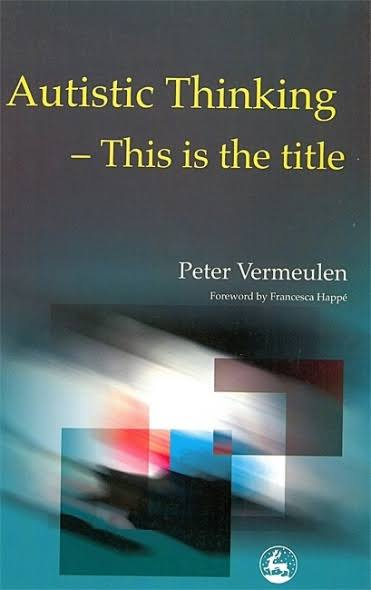
Autistic Thinking: This is the title
Vermeulen, P. (2001). Autistic thinking: this is the title. London: Jessica Kingsley Publishers. Vermeulen, P. (2002).
Articles:
Note:
Some of his articles are available online through his ResearchGate profile.
Vermeulen, P. (1998). Some impressions on autism and art: being au/rtistic. Link, 24 (3), 10-11. Vermeulen, P. (1999). I Am Special: a method and a workbook to introduce young people to their autism spectrum disorder. Paper presented at the Autism99 Internet Conference Vol. http//:www.autism99.org. Vermeulen, P. (2000). I’m special: a method to introduce children, adolescents and young adults to their autism spectrum disorder. Autism – Asperger’s Digest, September-October, 4-8. Vermeulen, P. (2001). C’est de famille. APEPA Info, 79 (Mai 2001), 16-24. Vermeulen, P. (2002). Ikke tro på alle løftene… Autisme i Dag, 29 (2), 95-100. Vermeulen, P. (2002). Ne croyez pas toutes ces belles promesses. La Lettre D’Autisme France, Nov (14), 12-14. Vermeulen, P. (2002). Autistic thinking: not seeing the forest for the trees. Autism Asperger’s Digest Magazine, Nov-Dec, 38-42. Vermeulen, P. (2002). Do not believe all the promises… Link, 34, 15-16. Vermeulen, P. (2002). Glauben Sie nicht an alle Versprechen… Link, 34, 16-17. Vermeulen, P. (2003). Ne croyez pas à toutes ces promesses. Info-APEPA, 86, 4-7. Vermeulen, P. & Vanspranghe, E. (2006). Psychological support of individuals with an autistic spectrum disorder. Good Autism Practice, 7 (1), 23-29. Descheemaeker, M.J., Govers, V., Vermeulen, P. & Fryns, J.P. (2006). Pervasive developmental disorders in Prader-Willi syndrome: The Leuven experience in 59 subjects and controls. American Journal of Medical Genetics, part A., 140A (11), 1136–1142. Vermeulen, P. (2011). Autism: from mind blindness to context blindness. Autism Asperger’s Digest Magazine, Nov-Dec, 39-41. Vermeulen, P. (2014). The practice of promoting happiness in autism – in: Jones, G. & Hurley, E. (Eds), Good Autism Practice: Autism, happiness and wellbeing. (pp. 8-17). Birmingham: BILD Publications. Vermeulen, P. (2015). Context Blindness in Autism Spectrum Disorder: Not Using the Forest to See the Trees as Trees. Focus on Autism and Other Developmental Disabilities, 30(3), 182-192 Vermeulen, P. (2018). Autism as contextblindness. Frontline: The Irish Voice of Intellectual Disability. Issue 109, 9 jan 2018. Autism as context blindess – Frontline article


This is a wonderful tribute to the pioneering work of Peter Vermeulen. His concept of "context blindness" is one of the most elegant frameworks for explaining how the autistic brain processes environmental cues, and his quote—"Autism refers to a typical way of understanding the world"—perfectly encapsulates the neurodiversity paradigm. The "I am Special" workbook was truly ahead of its time in promoting respectful, neuroaffirming psycho-education.
Vermeulen's work beautifully highlights that the foundation of true well-being and life satisfaction is self-knowledge. However, for many adults who grew up without these resources, the hardest part of the journey is simply finding a starting point to begin their own psycho-education and make sense of their past.
For those adults seeking that initial clarity,…