


How Do I Take My Child Out of School to Start Homeschooling in South Africa?

A clear, step-by-step guide for South African parents
Updated for the BELA amendments and DBE Circular S24 of 2025

Taking your child out of school to start homeschooling can feel overwhelming.
Parents often know that the current school environment is no longer working, but then face a new set of questions:
Can I simply take my child out of school?
Do I need permission?
Do I have to register?
Must I use CAPS?
What records do I need?
What assessments are required?
The process becomes much easier when you break it down into manageable steps.
Home education is a legally recognized educational option in South Africa under Section 51 of the South African Schools Act 84 of 1996, as amended by the Basic Education Laws Amendment Act 32 of 2024 (BELA).
The Department of Basic Education's Circular S24 of 2025 also provides important guidance about how the curriculum and assessment requirements of Section 51 should be implemented.
Here is the process, step by step.
1. Decide that home education is the right path for your child
There is no single educational environment that works for every learner.
Some children flourish in mainstream schools. Others thrive in smaller, alternative or specialized environments. And some children do significantly better through home education.
For some families, the decision follows months or years of anxiety, school avoidance, bullying, unmet learning needs, sensory overwhelm, academic mismatch or burnout.
For others, home education is simply a deliberate educational choice.
Home education is legally recognized in South Africa
Section 51 of the South African Schools Act recognizes home education as a valid educational option.
Broadly, home education is a purposeful educational program that is:
an alternative to attending school;
provided under the direction of the learner's parent;
primarily provided in the learner's home; and
able to include tutorial or other educational support.
This means you do not have to teach every subject yourself.
You may use tutors, online programs, curriculum providers, therapists, specialists, educational resources and other forms of support.
However, the parent remains responsible for directing and overseeing the child's home education.
For neurodivergent learners, I encourage parents to look beyond academic marks alone.
Ask:
Is my child safe? Are they able to learn? Are their support needs being met? Are they constantly overwhelmed or recovering from school? Is this environment allowing them to access their abilities?
Sometimes changing the environment is what makes learning accessible again.
2. Join the Pestalozzi Trust
Before withdrawing your child from school, consider joining the Pestalozzi Trust.
The Pestalozzi Trust is an independent public-benefit organization that provides legal and practical support to home-educating families.
Where possible, the Trust recommends becoming a member before withdrawing your child from school or before a dispute with educational authorities arises.
Members can also ask the Pestalozzi Trust to check their Provincial Education Department home education application before submitting it.
Important: Joining the Pestalozzi Trust does NOT register your child for home education with the Department of Education.
These are two separate processes:
Pestalozzi Trust membership = legal support and protection
Provincial Education Department application = statutory home education registration process where applicable
3. Understand the legal requirements
Before withdrawing your child, establish whether they are still within the compulsory-attendance period.
Following the BELA amendments, compulsory attendance begins from Grade R on the first school day of the year in which the learner reaches six years old. It continues until the last school day of the year in which the learner: turns 15 OR completes Grade 9 — whichever occurs first.
If your child is still of compulsory school-going age and you choose home education, Section 51 states that the parent must apply to the Head of Department of the relevant Provincial Education Department for registration for home education.
A learner registered for home education under Section 51 is exempt from ordinary school attendance.
What happens after the compulsory-attendance period?
Once your child has reached the relevant threshold — age 15 or completion of Grade 9, whichever occurs first — Section 51 does not require you to apply for home education registration or continue the phase-notification requirements under that section.
You are, however, still responsible for ensuring that your child receives an appropriate education and a valid school leaving certificate that is recognized in South Africa.
This distinction can be particularly relevant for families pursuing alternative high-school pathways and school exits such as a a NCV, American High School Diploma, GED, Cambridge, Pearson Edexcel or other international programs.
4. Gather your child's school documents
Before or when you withdraw your child, ask the school for copies of their educational records.
These may include:
latest school report;
previous academic reports;
academic records;
transfer documents;
assessment records;
support or accommodation plans;
concessions;
Individual Support Plans; and
other relevant educational or learning-support documentation.
Keep these records safely.
They can help you understand your child's academic history and determine an appropriate starting point for home education.
They can also be useful when identifying learning gaps, areas of strength and additional support needs.
5. Notify the school in writing
This is the practical step where you formally inform the school that your child is leaving.
Send a short, clear written letter or email to the principal stating that you are withdrawing your child from the school to continue their education through home education.
Include:
your child's full name;
their current grade;
their withdrawal date;
a clear statement that you are moving to home education; and
a request for any outstanding educational records.
Keep a copy of your letter, proof that it was sent and any response from the school.
Withdrawal and registration are two different things
This distinction is important.
Withdrawing from school ends your child's enrolment at that particular school.
Applying for home education registration with the DBE is the separate Section 51 process that applies where your child remains within compulsory school-going age.
You do not need the school's permission to decide that home education is the educational pathway you are choosing for your child. However, if your child remains of compulsory school-going age, you must still comply with the applicable Section 51 registration requirements of the Department of Basic Education.
6. Prepare your Home Education Plan
Now you can start designing an educational program around your child.
Your Home Education Plan should explain:
what curriculum or educational approach you intend to use;
the learning areas that will be covered;
the resources you will use;
how learning will take place;
how progress will be monitored; and
how the program is appropriate to your child's age, grade level and ability.
Do I have to use CAPS?
No.
This is one of the most important clarifications contained in DBE Circular S24 of 2025.
Circular S24 confirms that parents may choose:
CAPS • international curricula • faith-based programs • eclectic approaches • self-curated learning
provided that the educational program is predominantly comparable to the national curriculum.
“Comparable” does not mean “identical”
Circular S24 explains that comparable does not mean that the curriculum must contain identical content or have the same structure as CAPS.
Officials should instead consider whether the learner is engaging meaningfully across broad learning fields, developing skills and competencies over time, and receiving an educational experience with appropriate breadth and depth for their age, grade and developmental needs.
The Circular also makes it clear that Provincial Education Departments should not require lesson-by-lesson correspondence with CAPS or prescribe specific textbooks or teaching materials.
In other words:
Home education must meet an appropriate educational standard — but it does not have to replicate school.
Your child may learn through a combination of:
curriculum or online programs;
books and workbooks;
tutors and specialists;
projects;
practical learning;
documentaries;
educational outings;
therapies and support services;
co-ops and community activities;
interest-based learning.
And the parent remains responsible for directing and overseeing that education.
7. Apply to your Provincial Education Department
If your child remains within compulsory school-going age, complete the home education application required by your Provincial Education Department.
For example, families in the Western Cape apply through the WCED, while families in Gauteng, KwaZulu-Natal and other provinces apply through their respective provincial departments.
Administrative forms and processes can differ between provinces.
Your application should demonstrate that you understand your responsibility as the parent and explain the educational program you intend to provide.
Keep a complete copy of everything you submit.
Most importantly, keep proof of submission.
This might include:
an email receipt;
departmental reference number;
registered-post documentation;
courier receipt; or
stamped copy.
If you are a Pestalozzi Trust member, consider sending your completed application to the Trust for checking before submitting it to the Department.
8. Wait for the Department's response — and know about the 60-day provision
Section 51 contains an important provision for parents.
If the Head of Department does not respond within 60 days of receiving the application, the application is deemed to have been approved, provided that the applicant can prove that the application was submitted.
That is why your proof of submission is so important.
Create a dedicated home education folder containing:
Application → Supporting Documents → Proof of Submission → Departmental Correspondence → Registration Outcome → Assessment Reports
Do not throw away emails or reference numbers.
9. Start your home education journey
You can now begin implementing your home education program.
And this is where many new homeschool parents need reassurance:
Home education does not have to look like school at home.
You do not necessarily need six hours of desk work, rigid periods, endless worksheets or a school timetable recreated around the kitchen table.
Some children transition easily.
Others need time.
A child who has experienced chronic stress, school avoidance, anxiety or autistic burnout may need a gentler transition with shorter learning periods, predictable routines, lower demands and plenty of opportunities for regulation and recovery.
The legal obligation to provide a purposeful educational program remains, but a purposeful educational program can look very different from conventional school.
Learning can happen through:
📚 reading
💻 online programs
🧪 experiments
🌱 practical activities
🎨 creative projects
🎧 audiobooks
🌍 educational outings
🎥 documentaries
💬 conversations
♾️ special interests.
Focus on creating an environment in which your child can access learning.
10. Keep records of learning
Maintain a portfolio or other evidence showing your child's learning and progress.
This might include:
work samples;
projects;
assessment results;
online curriculum reports;
reading records;
photographs of practical activities;
certificates;
journals;
learning logs; and
progress summaries.
Circular S24 is helpful here because it recognizes a broad range of evidence.
This can include projects, drawings, photographs, records of practical work, journals, learning conversations and other evidence demonstrating educational progress.
Many online programs automatically generate progress reports, completion records and assessment results, which can make record-keeping easier.
Assessment does not always have to look like a school test
Circular S24 clarifies that assessment does not have to resemble a school-based CAPS assessment when the family uses a different curriculum or alternative assessment method.
For learning fields other than Mathematics and the language of learning and teaching, the Circular specifically recognizes portfolio-based and evidence-of-learning approaches.
The important question is:
What has this child learned, and how are they progressing?
11. Arrange assessments at the end of each phase
Section 51 requires the parent to undertake to arrange assessment by a competent assessor at the end of each applicable phase while the learner remains within the relevant compulsory-registration period.
The phase-end assessment points are:
Foundation Phase — Grade R–3
Assessment at the end of Grade 3
Intermediate Phase — Grades 4–6
Assessment at the end of Grade 6
Senior Phase — Grades 7–9
Assessment at the end of Grade 9
The assessment standard must not be inferior to the relevant National Curriculum Statement standard, and the signed assessment report must be submitted to the HOD as required.
Circular S24 gives useful guidance about what the competent assessor should consider, including the breadth and richness of the learner's educational experience, progress over time, phase-level outcomes and whether the overall program is coherent and suitable.
For eclectic and self-curated programs, the assessor should focus on meaningful engagement and developmental progression, rather than trying to match the child's education subject-by-subject with CAPS.
Need help with DBE registration or phase assessments?
Parents who would like assistance with the registration process or end-of-phase assessments can contact service providers like EduLivi.
12. Know your rights
Home-educating parents have rights as well as responsibilities.
The Provincial Education Department cannot simply refuse or cancel a home education registration without following the process required by Section 51.
Before refusing or cancelling registration, the HOD must:
inform the parent;
provide reasons;
give the parent a reasonable opportunity to make representations;
consider those representations; and
provide the required written decision and reasons.
A parent may also appeal a refusal or cancellation to the MEC for Education within 30 days of receiving notice of the decision.
Circular S24 further encourages Provincial Education Departments to provide support and written guidance, avoid inconsistent provincial interpretations, respect parental authority in determining an appropriate home education program and adopt a facilitative and supportive approach.
Remember: Circular S24 is guidance, not legislation
The underlying legal requirements come from the South African Schools Act as amended by BELA.
Circular S24 is interim DBE guidance about how the curriculum and assessment provisions of Section 51 should be interpreted and implemented.
This distinction matters if you encounter older provincial forms, websites or information that does not yet fully reflect the amended legislation.
Home education and the Neurodivergent Learner
For neurodivergent, autistic, ADHD, dyslexic, dyscalculic, gifted and twice-exceptional learners, one of the greatest benefits of home education can be the ability to create a program around an individual learning profile and neuro-profile.
Many neurodivergent learners have spiky or asynchronous profiles.
A learner may be years ahead in one area while requiring significant remediation or support in another.
A neuro-affirming home education program can therefore incorporate:
♾️ different pacing across subjects
♾️ acceleration in areas of strength
♾️ targeted support for learning gaps
♾️ sensory accommodations
♾️ movement and regulation breaks
♾️ additional processing time
♾️ executive-function support
♾️ assistive technology
♾️ project- and interest-based learning
♾️ alternative ways of demonstrating knowledge.
Individualization does not mean lowering educational expectations.
It means asking:
What barriers can we remove, and what supports will allow this learner to access their abilities?
Need help creating your child's Education Plan?
Choosing home education is only the beginning. The next question is often:
“What should my child actually do?”
If you are unsure which curriculum, grade level, subjects or learning pathway will best suit your child, an Eunoia Curriculum Screening can help you make a more informed and individualized decision.

The screening considers your child's current academic level, strengths, learning gaps, neurodivergent profile, support needs and longer-term educational goals to help build an Education Plan that fits the learner — rather than forcing the learner to fit the program.
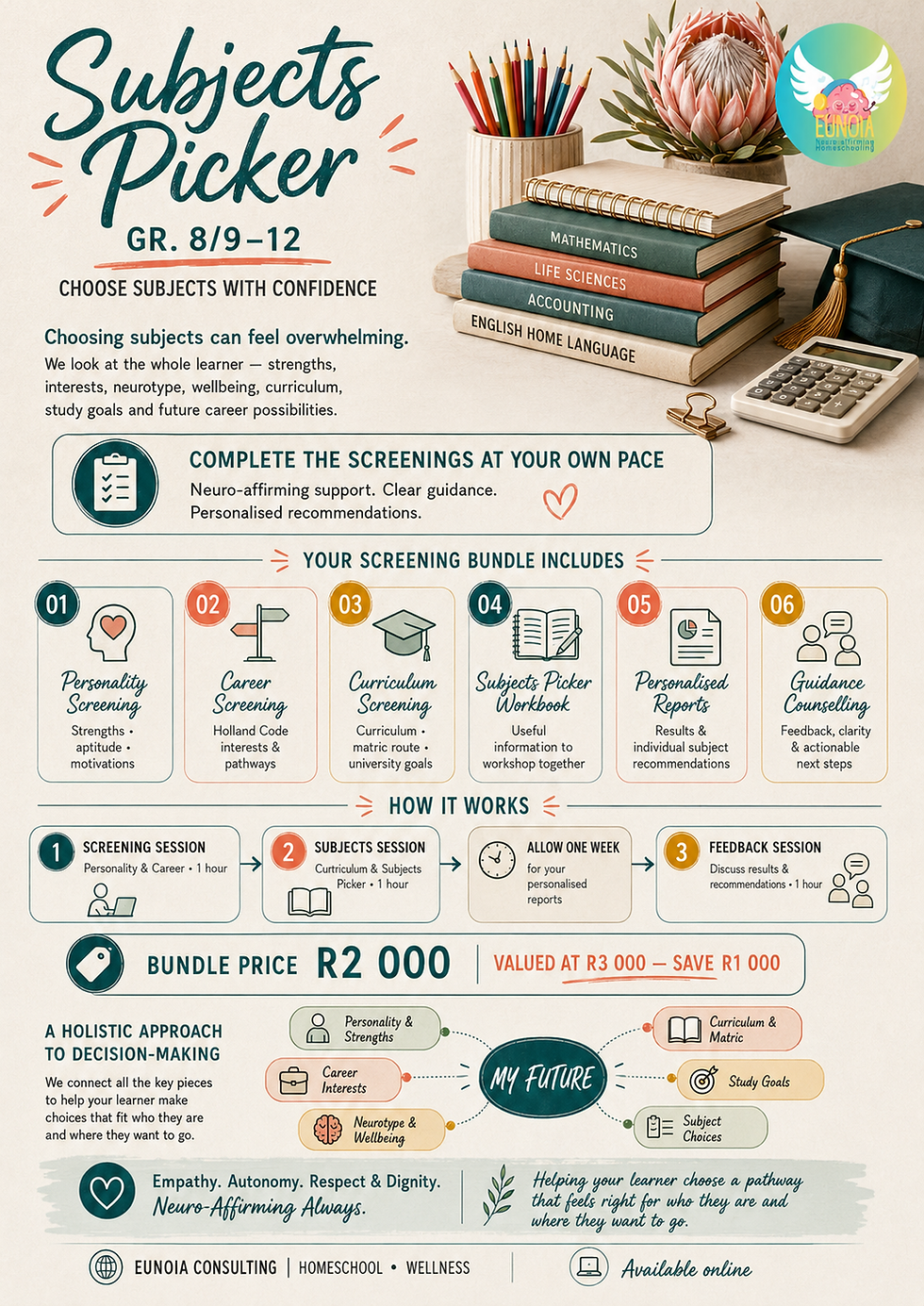
For high-school learners, an Eunoia Subject Picker Screening can help with choosing appropriate subjects while considering the learner's strengths and interests, future study and career options, school-leaving pathway and possible university entrance requirements.
Overview of how to take your child out of school to start homeschooling
The 12-step process at a glance is:
1. Decide that home education is the right path for your child
2. Join the Pestalozzi Trust
3. Understand the legal requirements
4. Gather your child's school documents
5. Notify the school in writing
6. Prepare your Home Education Plan
7. Apply to your Provincial Education Department
8. Wait for the Department's response and keep proof of submission
9. Start your home education journey
10. Keep records of learning
11. Arrange assessments at the end of each phase
12. Know your rights
Taking your child out of school does not mean stepping away from education.
Sometimes it means reimagining education.
Your child can learn through a different curriculum, at a different pace, in a different environment and through a different pathway while still receiving a meaningful education and meeting the applicable legal requirements.
Home education gives families an opportunity to ask a different question:
Not “How do we make this child fit the system?”
but
“How do we create an educational environment in which this child can learn, grow and thrive?”
Because different learners may need different paths.
Disclaimer: This article provides general educational information and does not constitute individual legal advice. Legislation, regulations and provincial administrative procedures may change. Parents should verify current requirements with their Provincial Education Department and seek appropriate legal advice where necessary.


Comments